

Executive summary
Phishing-resistant multi-factor authentication (MFA) elevates security by requiring a physical proof of presence that attackers cannot easily spoof, turning digital access into a “lock and key” problem rather than a purely credential-based one.
Why MFA is essential
Passwords alone remain the weakest link: human error drives the majority of breaches, and phishing is the single most effective attack vector because it targets people rather than systems. MFA raises the baseline by adding factors beyond passwords, sharply reducing account takeover risk and limiting the blast radius when credentials are compromised.
Why hardware-based MFA is the future
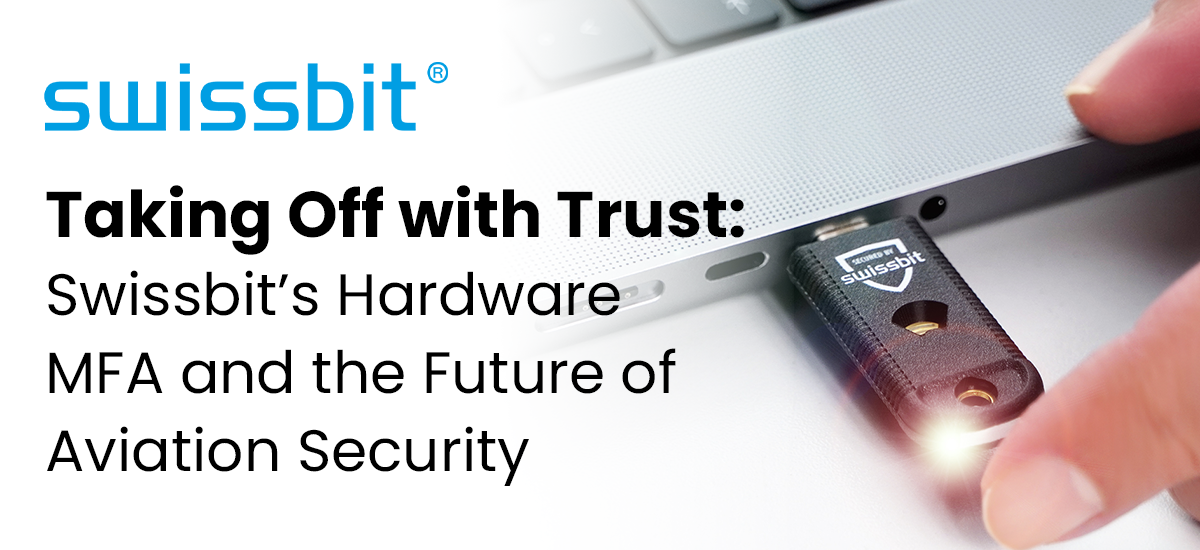
Hardware MFA (FIDO2 security keys, smartcards, secure elements) enforces phishing resistance by requiring a device or secure element that cryptographically proves presence and cannot be relayed or forged via a malicious webpage or intercepted push notification. Unlike SMS codes or push approvals, hardware tokens are inherently bound to the authentication flow and to the user’s device or biometric, which prevents social-engineering and man-in-the-middle techniques used by modern attackers.
Airline industry case study: risk profile and why hardware matters
Airlines operate high-value, high-availability systems spanning reservation platforms, crew communications, ground operations, and safety-critical avionics support tools. These systems combine widely used web portals, shared workstations in airports, and strict regulatory requirements, creating abundant phishing and credential-theft opportunities. A single compromised account can disrupt operations, leak passenger data, or even affect safety workflows. Hardware-based MFA solves two airline-specific problems: (1) shared or kiosk terminals where push-based MFA is fragile, and (2) environments where mobile devices are restricted or unsuitable, because physical keys or embedded secure modules provide a straightforward, auditable proof of presence that works even in constrained workflows.
How Swissbit addresses these needs
Swissbit provides hardware-based authentication solutions tailored for enterprise and industrial use cases, combining secure elements, FIDO2-compatible tokens, and robust lifecycle management that fits airline operational models. Their products offer tamper-resistant storage of credentials, strong device identity, and integration paths for replacing weak MFA methods without a full rip-and-replace of existing systems. Swissbit’s approach supports gradual rollouts, prioritising high-risk accounts and shared terminals first, aligning with best-practice incremental deployment to control cost while delivering immediate resilience gains.
Practical deployment recommendations for airlines
-
Start by protecting high-privilege and operational accounts (ops control, crew rostering, reservation admin) with hardware MFA.
-
Use FIDO2 tokens or embedded secure elements for kiosks and restricted areas where mobile MFA is impractical.
-
Roll out in phases: pilot in a single hub, measure operational impact and phasing, then expand to crew and ground staff; integrate tokens with identity management and logging for auditability.
-
Combine hardware MFA with user training and phishing simulations to shrink human risk while removing the easy path attackers use.
Conclusion
Phishing-resistant, hardware-backed MFA is a pragmatic, future-proof security pivot that converts human-targeted attacks into an access problem attackers can’t solve remotely. For airlines facing operational complexity and high-impact risk, adopting hardware MFA with vendors like Swissbit delivers both immediate protection and a scalable path toward stronger, audit-ready identity security.


